
On October 29th, Meta released its third-quarter financial report, with revenue reaching 51.24 billion US dollars, a year-on-year increase of 26%. Although it seemed strong, its net profit plummeted from 15.69 billion US dollars in the same period last year to 2.71 billion US dollars, a decline of 83%. One of the highlights of the financial report is that Meta predicts that the shipment volume of AI glasses will continue to rise in the fourth quarter. CEO Zuckerberg said that the newly released Meta Ray Ban Display smart glasses were nearly sold out within 48 hours, and the product demonstration appointments were fully booked until the end of November. The company has decided to increase investment to improve production capacity.
According to the semi-annual report on smart glasses released by JD.com on August 26th, the transaction volume of smart glasses in the first half of 2025 increased by more than ten times year-on-year, and the number of brands that have entered the market increased by three times. According to incomplete statistics, nearly 10 new products will be launched in the fourth quarter of 2025. IDC's forecast data shows that from 2024 to 2025, the shipment volume of smart glasses will increase by 248% year-on-year, and from 2025 to 2026, the shipment volume of smart glasses will grow by more than 250% year-on-year.
The year 2025 marks the explosive growth of the smart glasses market, with global shipments expected to exceed 14 million units and a growth rate in the Chinese market surpassing 120%. AI+ shooting glasses have become mainstream, and AI glasses for sports shooting have become a new hot spot. The integration of AI and AR is the next direction. Which manufacturers' new AI SoCs can empower more ecosystem partners? This article provides a detailed report and analysis.
AI SoC has become the brain of smart glasses. Currently, there are three mainstream chip methods
The main chip (SoC) is the "brain" of glasses, accounting for over 60% of the cost. Its upgrade is of vital importance.
Hao Pengpeng, senior design director of Verisilicon, told the media that current smart glasses SoC chips are divided into three major categories: large and comprehensive SoCs, such as high-integration platforms like Qualcomm, which have powerful functional units such as CPU, GPU, NPU and ISP, and can cover various computing and display requirements. However, it is costly and consumes a lot of power, making it unsuitable for lightweight and all-weather wearing scenarios.
Small and compact SoC: Focused on functions such as audio processing, low price, high maturity, suitable for single scenarios, such as voice assistants. However, its expansion capability is limited and it is difficult to support a composite AI experience.
Balanced solution: It strikes a balance among cost, function and power consumption, suitable for mid-range AI glasses, but the AI computing power is still limited and its scalability is restricted.
The design of AI glasses chips is undergoing a transformation from "general SoC adaptation" to "dedicated customized optimization". A Qualcomm technical expert told reporters that the battery of smart glasses is only 1/20 that of a smartphone, so the chip design must take uniqueness into account to ensure that it meets the requirements in terms of efficacy, and customized chip design is needed. Let's take a look at the latest chip advancements of the following three mainstream manufacturers.
Qualcomm has launched the AR1+ Plus, supporting the high-end smart glasses that Meta plans to release
On June 11, 2025, Qualcomm announced the launch of the brand-new Snapdragon AR1+ Gen 1 chip for high-end smart glasses. Compared with the base Snapdragon AR1 Gen 1 (already used in the Ray-Ban Meta glasses released at the end of 2023), the AR1+ Gen 1 is 26% smaller in size, 7% lower in power consumption, and supports a thinner design and longer battery life.
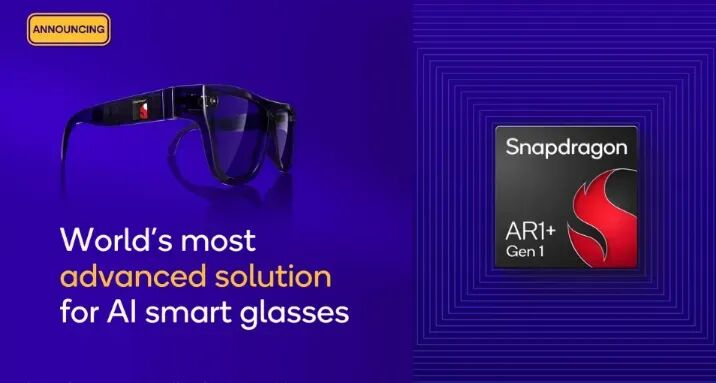
From Qualcomm's official website
The AR1+Gen1 chip is an upgraded version of small smart glasses chips such as Meta Ray-Bans. It is not suitable for high-end AR glasses that project 3D images.
Ziad Asghar, senior vice president of Qualcomm Technologies and general manager of XR business, said the new chip is 26% smaller. This will help future smart glasses look more like ordinary glasses, for example, with thinner frames. Smaller chips also leave more space for battery capacity. Despite its smaller size, the energy efficiency of the new chip will actually increase by about 5%.
The new chip has also improved the camera and image stability of smart glasses. The AR1+Gen1 chip has upgraded the image signal processor (ISP), significantly enhancing the quality of image and video capture. Built-in neural processing unit (NPU), capable of running Meta's Llama-3.2-1B (with a parameter scale of 1 billion) and other edge-side small language models.
It is learned that Qualcomm has not yet announced the specific partners that will adopt the AR1+ Gen 1 chip. The Verge reported that Meta plans to launch a high-end smart glasses code-named Hypernova by the end of 2025, equipped with a small single-eye HUD, and it may become the first device to be equipped with this chip.
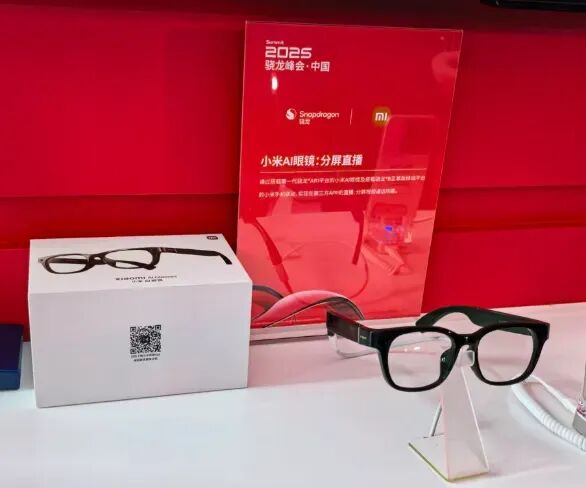
Allwinner V881 makes its debut, supporting 24M pixels and dual Wi-Fi6, assisting mainstream AI glasses
In May, Chen Zhixiang, the deputy general manager of Allwinner Technology's Smart Video Division, stated that in response to the demands of the smart glasses market, Allwinner Technology was the first to introduce the V821 chip and solution. On October 28th, at the Allwinner Technology booth in Hall 1 of the 2025 CPS Security Expo, the reporter saw the latest V881 chip and solution launched by Allwinner Technology.
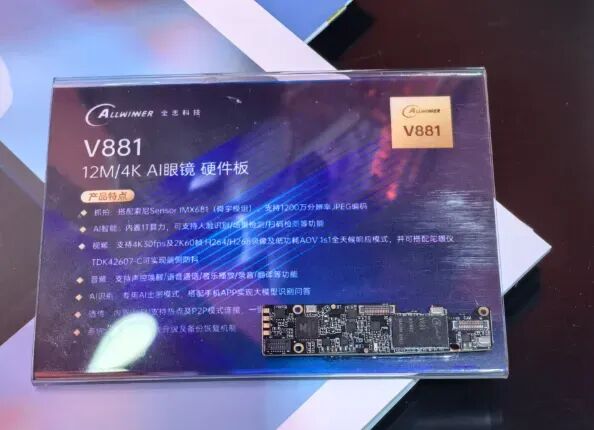
1. The Camera resolution has been upgraded from 4K to 24 million pixels. The V881 supports sensor input of up to 24M pixels and can simultaneously connect to three cameras. It can support the latest Meta Ray-Ban Gen 2 requirements released by Meta (supporting full-color high-resolution displays), including the requirements of future generations. Supporting narrow-bezel glasses, the V881 reduces the custom size to 6Xmm * 11.xmm.
2. The transmission performance has been significantly enhanced. The V881 integrates dual-band WiFi6 and Bluetooth 5.4 modules, providing a stable and low-latency wireless transmission channel for high-definition video streams. It offers higher transmission rates and lower power consumption. The memory has been upgraded from DDR2 to DDR4, with a 400% increase in download transmission rates and a 100% increase in capacity.
3. The V881 integrates a dual-core high-performance RISC-V CPU with a maximum main frequency of up to 1.4GHz, and integrates a 1 Tops NPU computing power that supports common CNN operators, achieving a coordinated improvement of general computing power and dedicated computing power, providing abundant performance support for complex front-end AI algorithms such as human figure tracking and scene recognition.

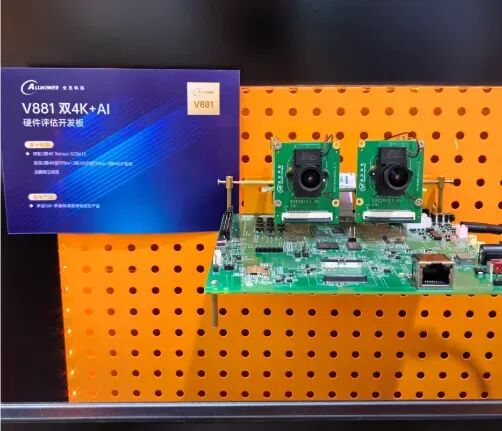
With the support of the RISC-V coprocessor, the V881 also supports low-power sleep wake-up and AOV solutions, enabling millisecond-level cold start sensor image output and cold start screen display solutions, balancing the multiple demands of high performance and low power consumption. The application fields of V881 not only include AI imaging devices such as AI glasses and handheld gimbal cameras, but also high-definition image transmission for drones, robot vision navigation modules, IPC devices in smart homes, and home companion robots, etc.
Staff members disclosed that Allwinner Technology plans to have three chips. The V821 chip will support basic AI glasses and is suitable for customers who value cost performance more. The V881 chip has more powerful imaging and computing capabilities, covering the demands of mainstream and flagship AI glasses SoCs. The next-generation V883 chip will focus on low power consumption, high resolution and high-end imaging, and will also support AI glasses.
Unisplendour Springsoft has launched the W517, which supports the application of AI glasses and AR glasses
In the past, AI+AR glasses generally adopted a dual-chip structure of "main SoC+ external coprocessor" to balance video codec and AI computing power. The result is that the PCB area exceeds 50× 30mm, the BOM cost often exceeds 200 US dollars, and the battery life is locked within 45 minutes, etc., which in turn leads to a persistently high return rate. The answer given by Gudong Intelligent is: directly switch to the domestic Unisoc W517 single-chip.
The domestic Unisoc W517 has a single chip size of only 10× 10mm. It integrates the CPU, GPU, ISP, DSP, Wi-Fi5, and Bluetooth 5.0 all into a silicon wafer the size of a fingernail, and features an ultra-large internal storage of 4GB RAM + 64GB ROM
Store space. After actual measurement, when using the self-developed hardware board of Gudong equipped with this chip solution to continuously play 1080P@30fps video, the battery life can reach 1 hour and 50 minutes, and the single-chip structure significantly reduces the BOM cost.
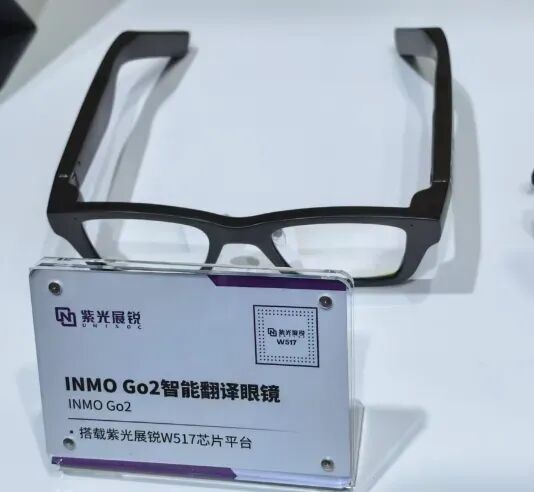
Electronic enthusiast reporters also saw the display of INMO Go2 smart translation glasses equipped with Unisplendour Spreadtrum W517 chip platform at the IOTE exhibition.
Xingchen Technology has launched the SSC309L, which supports smart glasses and low-power smart applications
Xingchen Technology was established in December 2017. The company focuses on the research and development and sales of audio, video and display SoC chips for the AI end side and edge side. Its products are widely used in intelligent security (such as IPC, NVR), automotive electronics, video intercom, smart home, robotics and other fields. The company was listed on the Growth Enterprise Market of the Shenzhen Stock Exchange in March 2024.
At the AI Internet of Things Forum of the 2025 CPS Security Expo, Chen Lijing, the deputy general manager of Xingchen Technology, stated that from 2021 to 2024, Xingchen Technology has been the largest chip supplier in the security field for five consecutive years, providing multiple chips in IPC Cam, NVR, and XVR.
In the smart glasses market, Xingchen Technology has specially developed a small-sized, low-power, and lightweight smart image processing chip, SSC309L, for smart glasses. Chen Lijing pointed out that when this chip is in fast standby mode, its power consumption is only 1 milliwatt. When shooting 2-megapixel H.264 Video, its power consumption reaches 320 milliwatts. Under the same functions, the power consumption of products from competitors is over 500 milliwatts. Support AI for AOV.
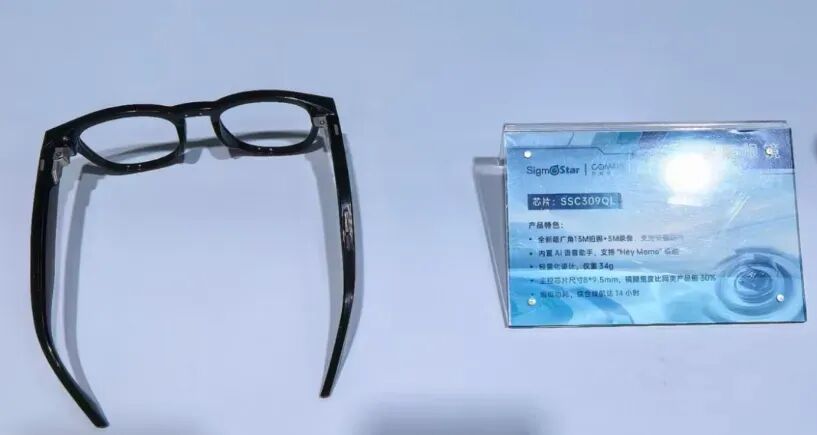
Including applications such as low-power drones, smart home devices, and smart cameras
Relying on its professional-level image processing technology advantages, this company has launched the SSC309QL highly integrated solution based on the Chiplet architecture - featuring an integrated LPDDR4 (2Gb) storage unit, which reduces the chip area and lowers the power consumption for video recording. Coupled with a low-power architecture design that combines software and hardware, The SoC's operating power consumption can be as low as 30mW, providing an "all-weather on-demand recording" experience.
免责声明: 本文章转自其它平台,并不代表本站观点及立场。若有侵权或异议,请联系我们删除。谢谢! Disclaimer: This article is reproduced from other platforms and does not represent the views or positions of this website. If there is any infringement or objection, please contact us to delete it. thank you! |

WeChat Official Account

WeChat Service
 Email
Email QQ
QQ 13823761625
