
Noise is generally expressed in decibels (dB) to indicate its magnitude, and the signal-to-noise ratio (S/N) is used to represent the extent to which noise affects the useful signal. When measuring the signal-to-noise ratio, it is usually indicated whether it is weighted or not. What are weighted and unweighted?
Before introducing weighting, let's first introduce the measurement bandwidth. Due to the spectral diffusion characteristics of noise, its measurement is meaningful only when the measurement bandwidth is specified. Only by using bandpass and weighted filters as required by technical specifications in noise measurement instruments can the differences between actual noise measurement results and noise indicators be accurately compared.
The most commonly used noise measurement bandwidth in broadcasting and civil audio frequency applications is 20Hz to 20kHz. According to the CCIR468 technical specification, it is 22Hz to 22kHz, which is roughly the same. If it is purely in communication applications, due to the voice requirements for communication quality being much narrower in bandwidth, the commonly used technical indicators are 300Hz to 3.5kHz.
Weighting: In fact, it is just adding a filter. Weighting is a special filter designed in a noise tester to simulate the characteristic that human hearing has different sensitivities to sounds of different frequencies. The use of weighted filters in measurement can make the measurement results more consistent with human ear perception compared with unweighted measurement results. The sensitivity of the human ear is uneven and varies with frequency. At the same time, the frequency response of the human ear also changes with the amplitude of the sound pressure level. For example, the following figure shows the equal-loudness frequency response curve of pure tones. Therefore, in applications such as audio equipment, weighted noise is more in line with practical applications. For instance, at the 100K high frequency, there is a lot of noise. If not weighted, the test results will be very poor, but the human ear simply cannot hear it.
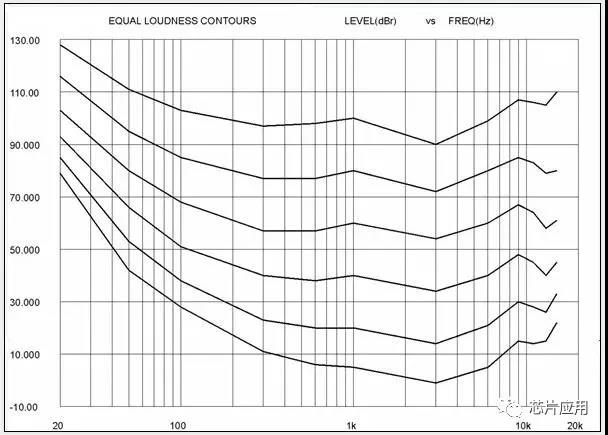
A-weighted: Different weighted filter developers assume different sound pressure level applications, so they use different curves in Fletcher-Munson. The one we are most familiar with is A-weighting. It is currently the most widely used indicator in the world, mainly because A-weighting simulates the loudness of A 40-square pure tone in the human ear. When the signal passes through, there is a significant attenuation in its low frequency and mid-frequency range (below 1000Hz). Because its characteristic curve is close to the hearing characteristics of the human ear, many noise-related specifications are based on A-weighting as an indicator.

免责声明: 本文章转自其它平台,并不代表本站观点及立场。若有侵权或异议,请联系我们删除。谢谢! Disclaimer: This article is reproduced from other platforms and does not represent the views or positions of this website. If there is any infringement or objection, please contact us to delete it. thank you! |

WeChat Official Account

WeChat Service
 Email
Email QQ
QQ 13823761625
