
During the charging process of lithium batteries, constant voltage charging is a crucial stage following constant current charging. When the battery voltage reaches the preset upper limit value, the charger will automatically switch to constant voltage mode, maintaining a constant voltage while gradually reducing the charging current until the charging is completed. This design is not only an important component of the battery management system, but also one of the core technologies to ensure the safety and service life of lithium batteries.
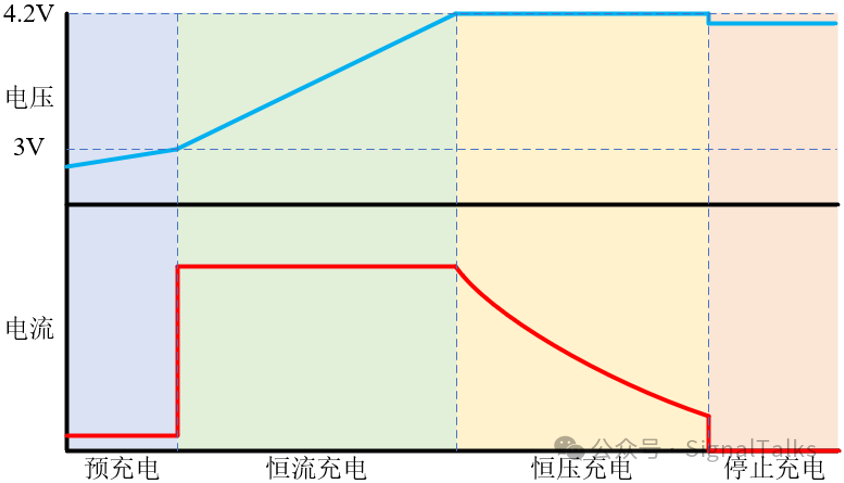
Among them, polarization voltage is a key concept for understanding the constant voltage charging stage of lithium batteries. In electrochemistry, polarization refers to the phenomenon where the actual potential of an electrode deviates from its equilibrium potential (theoretical open-circuit voltage), and this deviation value is known as overpotential or polarization voltage. In simple terms, it is because of the flow of current that the voltage of the battery "appears" is different from its "actual" voltage, that is

Therefore, when the measured voltage reaches 4.2V, the charger switches to keep this voltage constant. As there is still current injected, the actual voltage of the battery will continue to rise, but the measured voltage needs to remain constant. This leads to the polarization voltage having to decrease, and the polarization voltage is strongly correlated with the current, so the charging current must decrease. As the constant voltage stage progresses, the charging current will decay to a very small level, polarization becomes negligible, and the measured voltage is approximately equal to the battery voltage, completing the charging process.
If constant voltage charging is not adopted, at the end of constant current charging, in order to make the battery voltage reach 4.2V, charging must continue. Theoretically, if the polarization voltage value is clear, the measured voltage value when the battery is fully charged can be determined, and charging can be stopped when it reaches this value. However, the charging current is inconsistent in different application scenarios, making it difficult to unify the polarization voltage. This method is very likely to cause overcharging.
In summary, the constant voltage charging stage is essentially a process of safely and precisely charging the battery to a fully charged state by controlling the external voltage to automatically attenuate the charging current and reduce the polarization effect.
免责声明: 本文章转自其它平台,并不代表本站观点及立场。若有侵权或异议,请联系我们删除。谢谢! Disclaimer: This article is reproduced from other platforms and does not represent the views or positions of this website. If there is any infringement or objection, please contact us to delete it. thank you! |

WeChat Official Account

WeChat Service
 Email
Email QQ
QQ 13823761625
