
Source: ROHM
Shanghai, China, September 22, 2025 - ROHM, a globally renowned semiconductor manufacturer headquartered in Kyoto, Japan, announced today the launch of its two-in-one SiC module "DOT-247", which is highly suitable for applications in industrial equipment such as photovoltaic inverters, UPS, and semiconductor relays. The new module retains the universality of the "TO-247" widely used in power components, while also achieving higher design flexibility and power density.
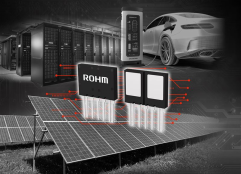
At present, although two-level inverters are the mainstream products of photovoltaic inverters, the demand for multi-level circuits such as three-level NPC, three-level T-NPC and five-level ANPC is increasing day by day to meet the higher voltage requirements. The switching parts of these circuits adopt a mixture of half-bridge and common-source topologies, etc. Therefore, if the previous SiC modules are used for adaptation, customized products are often required. For this topic, ROHM integrated the above two topologies, which serve as the minimum structural units of multi-level circuits, into a two-in-one module. This module not only has the flexibility to deal with the next-generation power conversion circuits, but also can realize circuits smaller than vertical devices.
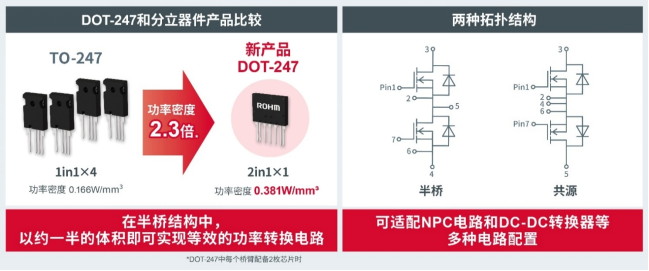
DOT-247 adopts a design that connects two TO-247 packages. By equipping large chips that are difficult TO accommodate on the TO-247 structure and using ROHM's own internal structure, it achieves a lower on-resistance. In addition, by optimizing the packaging structure, its thermal resistance is reduced by approximately 15% compared TO the TO-247, and the inductance is reduced by approximately 50%. Thus, in the half-bridge *1 structure, a power density 2.3 times that of the TO-247 can be achieved, and an equivalent power conversion circuit can be realized in approximately half the volume.
The new products adopting DOT-247 have two topologies: half-bridge and common-source, which can be adapted to various circuit configurations such as NPC circuits *2 and DC-DC converters. By using this product in these power conversion circuits equipped with multiple discrete devices, the number of components and installation area can be reduced, facilitating the miniaturization of application products and significantly cutting installation and design time.
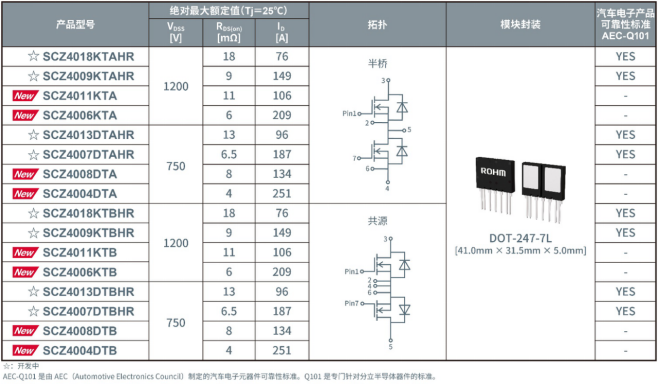
The product lineup includes four models with a 750V withstand voltage (SCZ40xxDTx) and four models with a 1200V withstand voltage (SCZ40xxKTx). The new product has been put into mass production at a monthly output of 10,000 units since September 2025 (sample price: 20,000 Japanese yen per unit, excluding tax). In addition, samples of products that comply with the automotive electronic product reliability standard AEC-Q101 are also planned to be provided starting from October 2025.
To facilitate customers' immediate evaluation during application design, ROHM will successively provide evaluation boards. Please contact ROHM sales representatives or inquire through the "Contact Us" section on the ROHM official website.
<Product Lineup>
<Application example>
Boost converters for photovoltaic inverters, semiconductor relays, UPS (uninterruptible power Supply unit), ePTO*3, and FCV (fuel cell Vehicle)
AI servers (eFuse), EV charging piles, etc
<Supporting information>
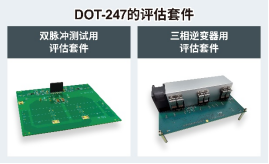
ROHM has equipment for conducting motor tests within the company, which can provide strong support at the application level. To accelerate the evaluation and application of DOT-247 products, ROHM also offers a variety of support resources, including a rich array of solutions ranging from simulation to thermal design, to help customers quickly adopt the products. In addition, ROHM also offers evaluation kits for dual-pulse testing, which can support customers to start testing immediately. The evaluation kit for three-phase inverters is currently under preparation, and the reference design is scheduled to be available starting from November.
·Regarding the design model of DOT-247
SPICE model: Already available on the product webpage of the corresponding model
LTspice Model: It is planned to offer a three-level NPC model on the web page starting from October 2025
LTspice is a registered trademark of Analog Devices, Inc.
When using the trademarks of other companies, please follow the usage methods stipulated by the rights holders.
For detailed information, please contact a ROHM sales representative or inquire through the "Contact Us" section on the ROHM official website.
<Regarding the "EcoSiCTM" brand>
EcoSiCTM is a component brand that uses silicon carbide (SiC), which has attracted much attention in the power component field due to its superior performance compared to silicon (Si). From wafer production to manufacturing processes, packaging and quality management methods, ROHM has been independently developing the technologies necessary for the upgrade of SiC products. In addition, ROHM adopts a consistent production system in the manufacturing process and has already established its position as an advanced enterprise in the SiC field.

? EcoSiC? It is a trademark or registered trademark of ROHM Co., Ltd.
<Term explanation>
*1) Half-bridge and common-source
The basic structure of a power conversion circuit composed of two MOSFETs. A half-bridge is a method where MOSFETs are connected in series up and down and output from the middle of their connection points. By alternately performing switching actions on high and low-side MOSFETs, the positive and negative polpolarity of the output voltage can be switched. This structure is widely used as a basic structure for high-efficiency power conversion in inverters and motor drive circuits, etc.
Common-source is a method of connecting the source pins of two MOSFETs and outputting them from their respective drains. The common connection of source pins can simplify the gate drive circuit and is suitable for application scenarios such as multi-level inverters.
2) Types of NPC series multi-level circuits
NPC (Neutral Point Clamped) is a multi-level circuit method that divides the output voltage into three levels: +, 0, and -, which can reduce the voltage load on the switching device. The "0V" state is generated by the midpoint, which is the connection point located between the positive voltage and the negative voltage.
T-NPC (T-type NPC) adopts a structure that replaces the diode used to stabilize the midpoint with switching devices such as MOSFETs, which can achieve more efficient operation. ANPC (Active NPC) actively controls the midpoint potential itself through switches, thereby achieving smoother output waveforms and higher-precision power conversion. T-NPC and ANPC are suitable for application scenarios that require higher output power and higher efficiency.
3) ePTO (electric Power Take-Off)
The system that uses the motor and battery Power of electric vehicles to drive external working machines or equipment (such as hydraulic pumps, compressors, etc.) of the vehicle is the electrified version of PTO (Power Take-Off) used in traditional fuel vehicles and is accelerating its popularization in environmentally friendly commercial vehicles and engineering operation vehicles.
免责声明: 本文章转自其它平台,并不代表本站观点及立场。若有侵权或异议,请联系我们删除。谢谢!
Disclaimer: This article is reproduced from other platforms and does not represent the views or positions of this website. If there is any infringement or objection, please contact us to delete it. thank you!
矽源特科技ChipSourceTek

WeChat Official Account

WeChat Service
 Email
Email QQ
QQ 13823761625
